Home › Blog › Job Documents › ATS-Friendly USA Resume
Job Documents · USA
ATS-Friendly USA Resume: How to Pass Screening in 2026
Published / Reviewed: 1 November 2026, updated 2 November 2026 · Reading time: 10 min · Reviewed by: NationsDocs Editorial Desk · Scope: USA only. This post is about the USA format; UK, Canada, and Pakistan formats differ and are covered separately.
ATS checklist: copy this before you send
Run through this list on the finished file, not on the first draft. Every point below is explained in the sections that follow.
- Single column, top to bottom, no tables, text boxes, graphics, or photos.
- Standard headings in order: Summary, Experience, Education, Skills, and Certifications only where relevant.
- Contact details in the body of the document, never in a header or footer.
- Standard font at 10 to 12 points, plain round bullets, and one consistent date format, for example Jan 2024 to Present, on every role.
- Save as .docx unless the posting asks for a text-based PDF.
- Mirror the exact job title once, in the summary or headline, only where it honestly matches your target role.
- Repeat each priority keyword two to three times in total: once in the summary or skills, and once inside a bullet that proves it. Include singular and plural variants where both are natural, for example dashboard and dashboards.
- Spell out every acronym on first use, for example Search engine optimization (SEO), then use the short form after that.
- Put name, job title, employer, and dates on separate lines, so no two fields are glued together on one line.
- Quantify results with true numbers you can defend in an interview.
- Tailor the summary, skills, and bullets to each posting. A generic resume sent unchanged to every job is the most common avoidable weakness.
- Run the two-minute plain-text test at the end of this post before you submit.
Agree first: your resume is read twice, and the first reader is software
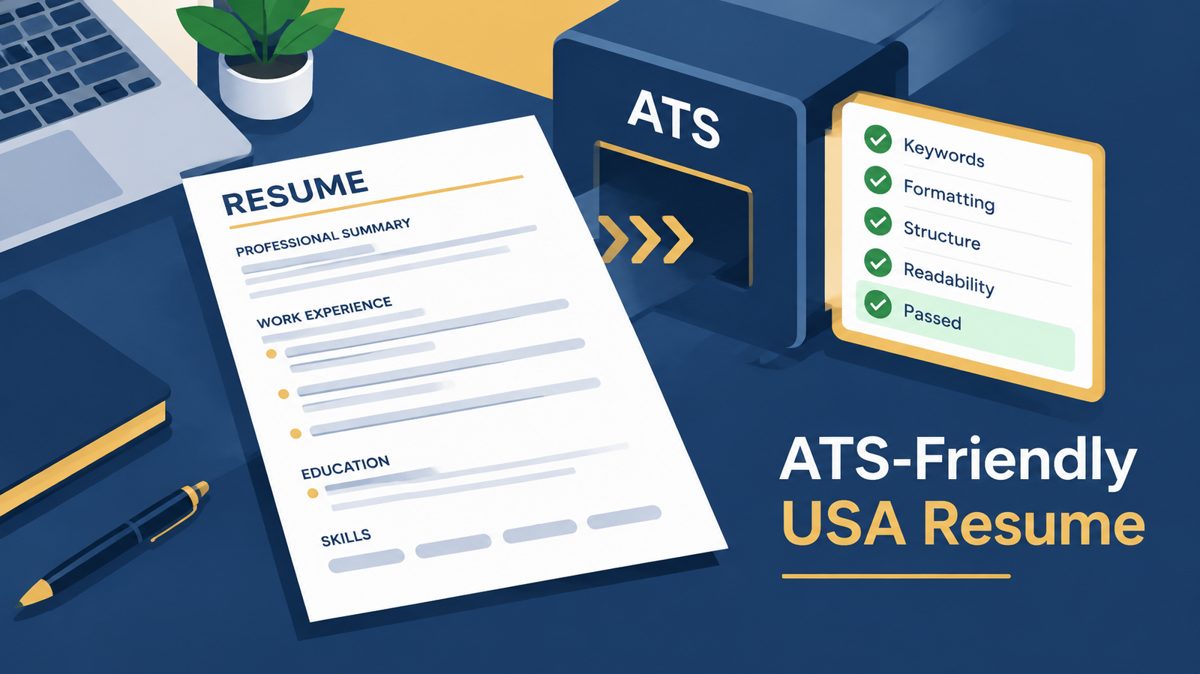
If you have sent a good-looking resume to US employers and heard nothing back, the problem may not be your experience at all. Most large US employers run the resume through an applicant tracking system, an ATS, before a recruiter ever opens it. That system does not admire your design. It extracts your file into plain text, guesses which line is your name, which block is a job, and which words are skills, and then files the result so a recruiter can search it. A beautiful two-column layout that looks perfect on screen can arrive in that system as scrambled text, with a skill glued to a job title and a date attached to the wrong role. This post explains, in plain order, how to build a USA resume that survives that first reading and still reads well for the human who comes second. It promises no score, no ranking, and no interview guarantee, because no honest guide can promise those.
What an ATS actually does, in six plain steps
- Ingestion: you upload a .docx or a text-based PDF.
- Text extraction: the system pulls the text out of the file. A scanned page or a screenshot saved as a PDF has no real text underneath, so there is nothing to extract.
- Parsing: it maps that text into fields: name, contact details, job titles, employers, dates, education, skills.
- Normalisation: dates, phone numbers, and titles are put into standard forms.
- Keyword and semantic matching: it compares the parsed content with the job description, increasingly for context, not only for exact word counts.
- Filtering and ranking: recruiter rules and a match score decide which resumes reach a human.
The practical lesson is mechanical, not magical. If the file cannot be extracted cleanly, the matching step never gets a fair chance to judge your experience.
The format that survives parsing
Build from a blank single-column file, top to bottom, left aligned. Use standard headings in this order: Summary, Experience, Education, Skills, and Certifications only where relevant. Avoid creative headings such as My Journey, because a parser looking for Experience may not recognise them. Put your contact block in the body of the document, never in a header or footer, because some parsers skip header and footer regions entirely. Use a standard font such as Arial, Calibri, or Times New Roman at 10 to 12 points, plain round bullets, and one consistent date format, for example Jan 2024 to Present, on every role. Save as .docx unless the posting asks for PDF, and if you send a PDF, make sure it is a true text PDF, not an image. Length: one page under about ten years of experience, two pages above that. Extra length without extra signal hurts you with both the software and the human.
What breaks parsing, and what to use instead
- Two columns and sidebars: the reader can mix the sidebar with the experience column. Use one column instead.
- Tables, text boxes, and graphics for key content: dates in separate table cells can be read as blank or attached to the wrong job. Use plain stacked job blocks instead: title, company, location, dates, then bullets, one role fully finished before the next begins.
- Icons and skill bars: a bar has no text value. Write the skill as a word, inside a bullet that proves it.
- Headers, footers, and images carrying text: move that text into the body.
- Functional resumes that hide the dated history: a parser needs the dated work history to map your career. Keep reverse-chronological order.
Small mistakes that break parsing
These are separate from the big layout mistakes above, and they are easy to miss because the resume still looks fine on screen.
- Mixed date formats: using 01/2024 on one job and January 2024 on the next confuses normalisation. Pick one format, for example Jan 2024 to Present, and use it on every role, including education.
- Acronyms with no expansion: a system searching for the full phrase may miss a skill written only as initials. Write the full phrase once, with the acronym in brackets, then use the short form.
- Two fields on one line: a job title and its dates on the same line, or a name and a phone number on the same line, can be read as a single field. Keep name, title, employer, location, and dates on separate lines.
- Decorative bullets: stars, ticks, and icons can drop out or turn into stray characters. Use plain round bullets only.
- Contact details in a header or footer: some parsers skip those regions, so your phone number and email may never be extracted at all. Keep them in the body, at the top of page one.
- Keywords with no proof: a skill listed ten times and never shown in a bullet reads as stuffing to a human reviewer, even if a simple counter likes it. The checklist rule is two to three appearances in total, each one tied to real work.
Keywords the honest way: mirror the posting, only for real experience
Read the posting and note the exact skill words it repeats, then use those exact words, but only inside bullets that prove real work. If the posting says stakeholder communication and budget oversight, and you have genuinely done both, those phrases belong in the bullets that show them, not in a long list at the bottom with no proof behind it. Modern screening increasingly reads context, so a keyword with no supporting work behind it helps less than it used to, and keyword stuffing, hidden text, and invented skills damage trust when a human checks. The summary at the top deserves special care: three or four sentences that name the target role and the most relevant real skills, because that is where both the system and the recruiter look first. As a working rule, repeat each priority keyword two to three times in total, once in the summary or skills section and once inside a bullet that proves it, and mirror the exact job title once in the summary or headline where it honestly matches your target role. Include singular and plural variants where both are natural, for example report and reports, because a system may search for either form. Tailor this for each posting: keep the same structure, but revise the summary, skills, and bullets so they reflect the wording of that role, without overstating your experience.
ATS-friendly resume example
The example below is fictional, invented only to show the layout and the checklist in action. It is not a real person's career, and none of the numbers in it belong to a real applicant.
Jordan Lee
Chicago, IL · [email protected] · 312-555-0148
Summary
Data Analyst with experience in SQL dashboards, data visualization, and client reporting, gained across three years of reporting work for operations teams.
Experience
Data Analyst, Wavewood Systems, Chicago, IL, Jan 2021 to Present
- Built SQL dashboards and data visualization reports for managers, improving the accuracy of weekly client reporting.
- Used Python and Excel to analyse customer data and identify trends for product teams.
- Created dashboard summaries that helped managers track performance across five regions.
Education
Bachelor of Science in Statistics, ABC University, May 2020
Skills
SQL, Python, data visualization, dashboard development, client reporting, Excel, Tableau
Notice what the example does: one column, standard headings, contact details in the body, dates in one format, plain bullets, the exact skill words repeated in the summary, the bullets, and the skills list, and every number tied to a bullet a human could ask about. That is the pattern to copy with your own true history, not the numbers themselves.
A fictional before and after
The example below is fictional, invented only to show the writing pattern. It is not a real person's career.
Before, duties only: Responsible for warehouse operations and team coordination.
After, proof in one bullet: Led stock validation across three warehouse sites, cutting monthly stock errors from 42 to 11 in four months.
The second bullet works because it has four parts: a strong verb, an object, a constraint, and a result. Apply that pattern to your own real work, with numbers that are true and that you can defend in an interview. Never add a percentage, a salary, or a project that did not happen.
The pre-send test that takes two minutes
- Select all the text in your resume file and copy it into a blank document. If the order scrambles, a parser will scramble it too.
- Check that every heading, job title, date, and skill survived in the right order.
- Check the file type the posting asks for, and send that type.
- Read the pasted text once as a recruiter would: does the first screen show the target role, the relevant skills, and the most recent role clearly?
Frequently asked questions
How do I make my resume ATS friendly?
Make your resume ATS friendly in five steps: use a single-column layout, use standard headings (Summary, Experience, Education, Skills), use a standard font at 10 to 12 points, mirror the job posting's exact skill words only where they are true, and save as .docx unless the posting asks for a text-based PDF. Then run the plain-text test in the section above.
What is the best ATS friendly resume format for USA jobs?
The best ATS friendly resume format for USA jobs is a reverse-chronological, single-column document with no tables, columns, text boxes, graphics, or photos, with contact details in the body, consistent month and year dates, and one page for most applicants and two pages only with about ten or more years of relevant experience.
How do I test or check my resume for ATS?
Copy all the text into a plain-text editor. If the order scrambles, headings disappear, or dates attach to the wrong job, the ATS will struggle too. Fix the layout first, then check that every required skill from the posting appears once in a skills section and once inside a bullet that proves it. No third-party score can guarantee an interview, and chasing a perfect score is the wrong goal.
Is PDF or .docx better for a USA resume?
Both work when the file is clean text in a single column. Many older enterprise portals parse .docx most predictably, so send .docx unless the posting specifically asks for PDF.
Does an ATS reject most resumes?
Claims of a single rejection percentage circulate widely and vary by employer, system, and role, so treat any one number with caution. What is certain is that a file that cannot be parsed cleanly cannot be judged fairly, whatever the employer's rate is.
Can NationsDocs prepare this format?
Yes. The USA Services page covers the ATS-friendly resume, delivered as an editable Word file plus a clean PDF after approval, with one free words-only revision. The first post in this job-documents cluster, The Complete Guide to Resumes and CVs by Country, explains how the USA format differs from the UK, Canada, and Pakistan formats, and the Blog index lists every post in the cluster as it is published.
For the Canadian side, see Canada resume format.
Need this document prepared?
Order through NationsDocs and get an initial draft preview within 2 hours of cleared payment and complete details.