Home › Blog › Job Documents › USA Cover Letter
Job Documents · USA
How to Write a USA Cover Letter for a Job Application
Published / Reviewed: 3 November 2026 · Reading time: 8 min · Reviewed by: NationsDocs Editorial Desk · Scope: USA only. This post is about the USA format; the UK format differs and is covered separately.
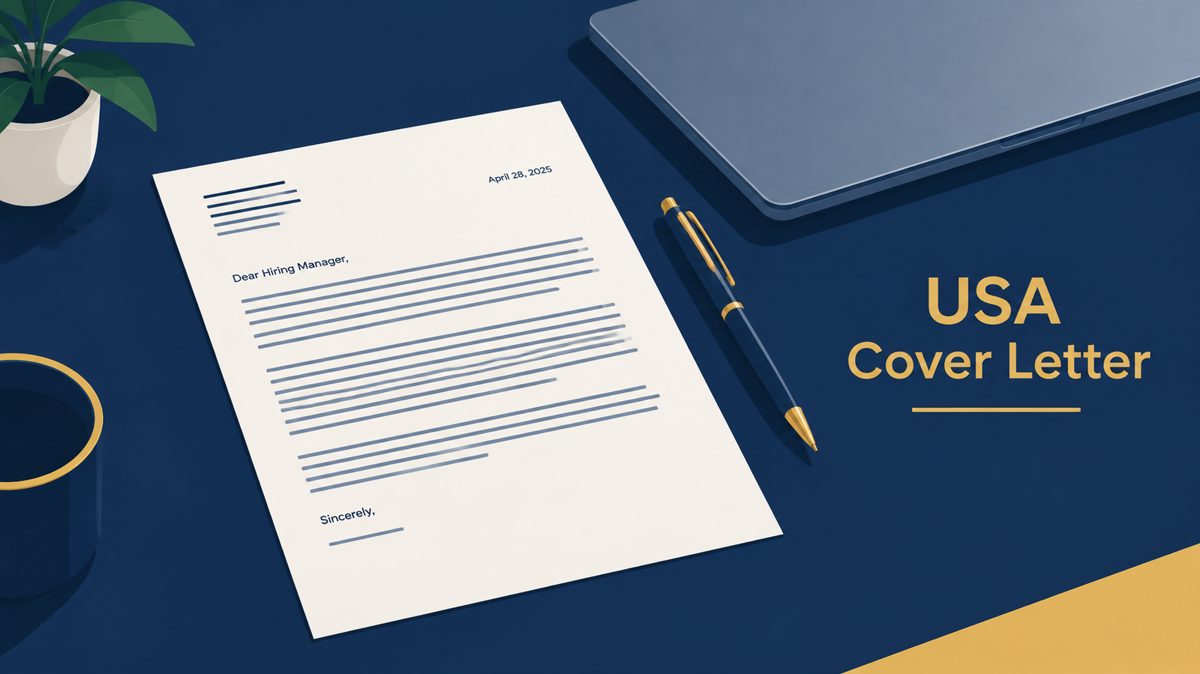
Agree first: the resume lists the facts, the letter makes the case
If your USA resume already lists your jobs and skills, you may wonder what a cover letter can add. The answer is focus. A resume must cover a whole career, but a letter covers one job only: it names the exact role, picks the two or three proofs that matter most for that role, and explains why you want this employer in particular. That is the whole job of the letter, and it is why a generic letter that could be sent to any company helps so little. This post shows how to write a USA cover letter for a job application in one page, in the order a hiring manager expects, with a fictional example you can adapt to your own real experience. It promises no interview and no offer, because no honest guide can promise those.
How to write a USA cover letter for a job application
Work in this order, and keep the full letter to one page, about 200 to 400 words in 3 to 4 paragraphs. Write a fresh letter for each position, even when two postings look alike, because the proof that matters changes with the job description.
- Header. Your name, city and state, phone number, and email address at the top, then the date in US format, then the hiring manager's name, title, and company where you know them. If you are applying by email or through a portal that already holds your contact details, a shorter header is acceptable; the posting's own instructions come first.
- Greeting. Address the letter to a named person where you can find one, for example "Dear Ms. Rivera:". The colon after the name is the usual US business style. If no name is published, "Dear Hiring Manager," is the safe fallback. Do not use "To Whom It May Concern", which reads as dated and untargeted.
- Opening paragraph. Name the exact job title, say where you found the posting, and give one line that connects your strongest relevant qualification to the role. If a named person referred you, say so in the first sentence.
- Proof paragraphs. One or two short paragraphs, each built around one real achievement that matches a requirement in the posting. Give the result, not only the duty. Keep each paragraph to 3 to 5 sentences.
- Closing paragraph. Restate your interest in this role and this employer, thank the reader, and say how you will follow up or that you welcome an interview. Close with "Sincerely," followed by your typed name.
Format at a glance
- Length: one page, 3 to 4 paragraphs, about 200 to 400 words. Shorter email and portal versions are covered below.
- Font and margins: the same standard font as your resume, 10 to 12 points, with 1 inch margins, single spacing, and a blank line between paragraphs. Do not indent paragraphs.
- File type: PDF for an attachment, unless the posting asks for another format, so the layout cannot shift on the reader's screen. Use a clear file name, for example Firstname_Lastname_Cover_Letter.pdf, with your own name in place of the placeholders.
- Tone: direct, professional, and specific. US letters usually use "I" for your own achievements rather than hiding them behind team wording.
- What to leave out: age, marital status, religion, immigration status, salary history, and anything the posting did not ask for. Do not repeat the whole resume, and do not claim a skill or result you cannot defend in an interview.
When to send one, and when to skip it
Send a letter when the posting asks for one, when the role involves writing or client communication, when you have a referral to mention, or when your resume alone does not explain a career change or a gap. In those cases the letter does work the resume cannot do. If the posting says the letter is optional, a short, tailored letter is still worth sending for a role you genuinely want, provided you have something specific to say. Skip a letter only when the employer says not to include one, or when the application system gives you no place for one; do not force it into a resume upload or an unrelated text box. Never send a generic filler letter instead of no letter at all: a letter that names no real requirement of this job signals mass applying, and that can hurt more than silence.
A fictional example, paragraph by paragraph
The example below is fictional, invented only to show the writing pattern. It is not a real person, a real company, or a real application.
Opening, fictional: "Dear Ms. Rivera: I am writing to apply for the Customer Support Specialist role advertised on your careers page. In my current support role I resolve about 40 customer cases a week, and I am applying because your team's focus on first-contact resolution matches the work I do best."
Proof, fictional: "Last year I rebuilt the reply templates for the three most common billing questions, which cut repeat contacts on those topics and gave new team members a consistent starting point. I also trained two new colleagues on the same templates, so the improvement survived beyond my own caseload."
Closing, fictional: "I would welcome the chance to bring that same practical approach to your support team. Thank you for considering my application. I am available for an interview at your convenience. Sincerely, Maya R."
Notice what each paragraph does: the opening names the role and one strength, the proof paragraph shows one change with a consequence, and the closing asks for the next step without repeating the resume. Replace every fact with your own real work, and keep the same shape.
Explaining a career change or a gap, in two sentences
Do not hide a change or a gap, and do not spend half the letter apologising for it. One honest sentence that names what happened, followed by one sentence that names what you bring now, is enough. For a career change, connect a transferable skill from the old field to a stated requirement of the new role. For a gap, state the period plainly, name any relevant learning or work done in that time only if it is true, and move on to the proof. The letter is judged on fit for this job, not on a full life history.
Email body, PDF attachment, or portal text box
Use the version the posting asks for. Where no version is specified, follow this guide:
- Email body: write a tight version of about 150 to 250 words in the email itself: role, two proof points, and a pointer to the attached resume. Skip the date and address block, because the email header already carries that information. Keep the subject line clear, for example "Application: Customer Support Specialist, Maya R.", with your own name and the real job title.
- PDF attachment: use the full one-page letter, and keep the email body to two or three courteous lines that name the role and the attachments. Do not paste the full letter into the email and attach the same letter again.
- Portal text box: paste the greeting and paragraphs only, without the header block, and check how the text renders before you submit, because most boxes strip formatting. Respect any character or word limit the box states, even if that means a shorter letter.
USA cover letter vs UK cover letter: the differences that matter
The two formats are cousins, not twins. A USA letter uses a colon after the greeting name, the month-day-year date order, and "Sincerely," as the standard close, and it usually stays at one page even for experienced applicants. A UK letter more often uses a comma after the greeting, the day-month-year date order, and the "Yours sincerely" or "Yours faithfully" rule depending on whether a name was used. The UK graduate letter is covered in its own post in this cluster, so this post stays with the USA rules only. Mixing the two, for example a UK close on a USA application, is a small error, but it is exactly the kind of small error that tells a reader the letter was not written for this country.
Frequently asked questions
How long should a USA cover letter be?
One page, 3 to 4 paragraphs, about 200 to 400 words for a standard letter. An email body or portal version should be shorter, about 150 to 250 words. If the posting states its own limit, follow that limit exactly.
Do I need a cover letter if the posting says optional?
Send a short, tailored one if you have something specific to say about this role and this employer, especially for a competitive or writing-heavy role. Skip it only if the employer says not to include one, or if you would otherwise send a generic letter with nothing specific in it.
Should I send it in the email body or as an attachment?
Follow the posting first. Otherwise, use the email body for a short version when you apply by email, and a PDF attachment for the full one-page letter when the posting asks for a document. Do not send both versions of the same letter at once.
Dear Hiring Manager, or a name?
A name is better where the posting, the company site, or a professional profile publishes one. Where no name is available, "Dear Hiring Manager," is the accepted fallback. Avoid "To Whom It May Concern".
Do federal jobs need a cover letter?
Only where the USAJOBS announcement asks for one. For federal roles, the federal resume and any assessment questions carry the decision first, so put your effort there and add a letter only when requested.
Can NationsDocs prepare this document?
Yes. The USA Services page covers cover letter preparation, delivered as an editable Word file plus a clean PDF after approval. The first post in this job-documents cluster, The Complete Guide to Resumes and CVs by Country, explains how the USA format differs from the UK, Canada, and Pakistan formats, and ATS-Friendly USA Resume covers the resume that goes with this letter. See also the NationsDocs Blog for the full cluster.
Authoritative guidance: CareerOneStop: How do I write a cover letter? and Columbia University: How and Why to Write a Great Cover Letter. Both are linked, not reproduced, here.
Need this document prepared?
Order through the USA Services page and provide your real details for a tailored draft.